


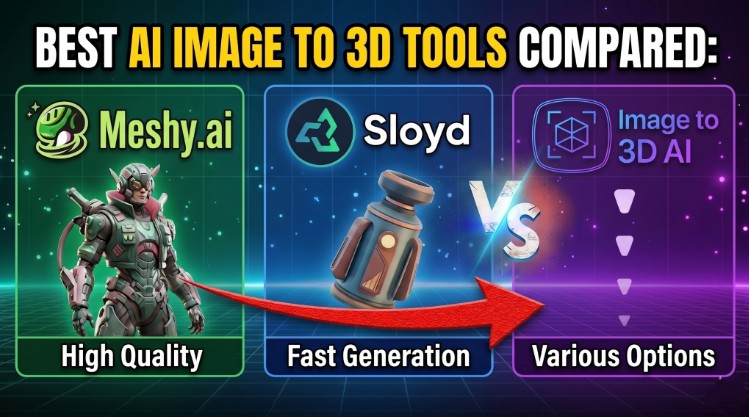
Best AI Image to 3D Tools Compared: Meshy vs Sloyd vs Image to 3D AI
In today’s rapidly evolving digital content landscape, transforming a 2D inspiration into a 3D reality is no longer the exclusive privilege of traditional 3D artists. The maturity of image to 3d ai technology is fundamentally reshaping the production pipelines of video game development, animation, 3D printing, and e-commerce. Whether you are an indie game developer in urgent need of massive environmental props, or a conceptual designer looking to validate ideas instantly, a reliable image to 3d model ai tool can compress hours or even days of meticulous sculpting into just a few seconds.
However, faced with an explosion of new AI-powered three-dimensional generation platforms, creators often fall into analysis paralysis. Today, we will shine a spotlight on three of the most prominent solutions in the current market: Meshy AI, Sloyd AI, and the standalone platform known as Image to 3D AI. We will conduct a comprehensive cross-comparison based on generation quality, mesh topology, control flexibility, and pricing models to help you find the perfect “Swiss Army knife” for your specific workflow.
Meshy AI: The Professional Standard for Clean Topology and PBR Textures
Meshy is widely recognized as one of the elite players in the AI 3D generation arena. Its core philosophy revolves around delivering “production-ready” assets directly into professional creative workflows.
Core Technology and Key Advantages
When processing a 2D image, Meshy does not just guess the general volume of an object; it puts immense engineering effort into mesh topology and material mapping. While many generic AI tools output an unorganized mess of dense triangles (Delaunay triangulation) that cannot be easily rigged or animated, Meshy introduces an intelligent retopology mechanism. It allows users to choose between structured quads or optimized triangles, which is critical for optimization in game engines like Unity and Unreal Engine.
Furthermore, Meshy’s PBR (Physically Based Rendering) texture generation is top-tier. Instead of producing a flat color texture (Albedo), it simultaneously bakes normal, metallic, and roughness maps up to 4K resolution. This ensures that the generated assets react realistically to dynamic lighting conditions in any professional rendering environment.
Ideal Scenarios and Limitations
- Best for: Game characters/props basemeshes, cinematic concept assets, and rendering scenes that demand high-fidelity PBR textures.
- Limitations: Its algorithms are highly sensitive to the quality of the input image. If the image has heavy embedded shadows, harsh specular reflections, or a cluttered background, Meshy might misinterpret the depth, resulting in geometric distortion. Additionally, because its process involves complex retopology and multi-map baking, generation times typically range from 30 seconds to 2 minutes, lacking “instantaneous” feedback.
Sloyd AI: The Hybrid Master of Parametric Templates and Generative AI
Sloyd takes a fundamentally different technical path. Rather than relying entirely on the “black box” of pure deep learning generation, it innovatively merges parametric modeling with generative AI.
Core Technology and Key Advantages
In Sloyd’s ecosystem, the AI doesn’t hallucinate what the backside of a 2D image looks like from scratch. Instead, it first identifies the object and matches it against an extensive library of hand-crafted parametric templates. For example, if you upload an image or type a prompt for a longsword, Sloyd recognizes the category “Weapon – Sword,” fetches a clean, pre-made template of a blade, guard, and hilt, and then automatically adjusts the parameters (such as blade length, guard width, and handle thickness) to match the proportions of your image.
This unique “AI-driven template” mechanism offers two game-changing advantages:
- Impeccably Clean Geometry: Because the underlying foundation is a human-built parametric model, the wireframe is perfectly neat and optimized for Low-Poly aesthetics. You will never encounter the “melted” or jagged artifacting typical of pure AI generation.
- Unrivaled Customization: Once the model is generated, you can still use Sloyd’s interactive web editor to manually tweak specific dimensions via sliders, or instantly swap styles (e.g., converting a high-poly asset to low-poly, or preparing it for 3D printing).
Ideal Scenarios and Limitations
- Best for: 3D printing enthusiasts (offering one-click STL export and automatic solid/base generation), and indie game developers needing to populate vast environments with mid-to-background assets (like trees, crates, and simple buildings).
- Limitations: Creativity is constrained by the template library. If you want to generate an otherworldly Lovecraftian monster or a highly abstract, asymmetrical piece of modern art that has no real-world equivalent, Sloyd will struggle because it cannot find a corresponding baseline skeleton in its database.
Image to 3D AI: Zero-Threshold Rapid Prototyping
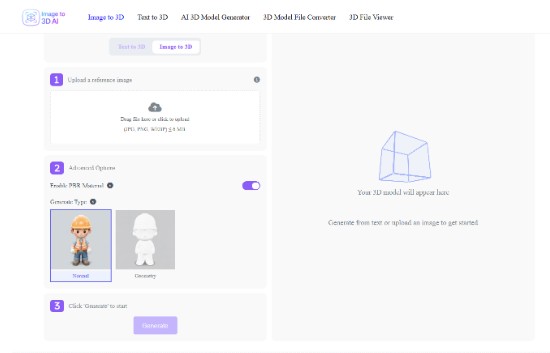
Image to 3D AI is a highly efficient, dedicated web-based tool built squarely around pure end-to-end neural reconstruction models. It leverages advanced cloud-based mesh diffusion and state-of-the-art algorithms to deliver fast, highly accurate 2D-to-3D conversions.
Core Technology and Key Advantages
This tool focuses heavily on “what you see is what you get” speed and maximum visual fidelity. It generally requires zero knowledge of 3D terminology; the user interface is stripped down to a simple, intuitive upload zone where you can drag and drop your source file.
The underlying AI models are pre-trained on massive datasets pairing 2D images with complex 3D structures, giving the tool incredible spatial imagination. Even if you provide a single front-facing view of an intricate object or character, the tool can intelligently “brainstorm” and generate the hidden sides, folds of clothing, and prop details on the back. In as little as 20 seconds, a fully textured 3D model appears in your browser, ready for multi-angle previewing.
Another major benefit of Image to 3D AI is its native multi-view mapping support. If you have three or four photos of an object from different angles (such as front, back, and side profiles), feeding them into the platform results in highly accurate geometric reconstructions, acting like a lightweight, AI-driven photogrammetry studio without requiring expensive local hardware.
Ideal Scenarios and Limitations
- Best for: Rapid prototyping, quick e-commerce product previews, 3D printing hobbyists looking for watertight forms, and concept artists looking to quickly assemble diverse assets for kitbashing or over-painting.
- Limitations: While the visual appearance and textures are incredibly accurate to the source image, inspecting the wireframe can sometimes reveal dense, chaotic mesh fragments. Although the platform offers basic built-in remeshing features, complex models may still require slight manual cleanup in software like Blender or Maya if you intend to execute complex rigging or skeletal deformations.
Head-to-Head Comparison: Feature Matrix
To help you easily visualize the technical differences and commercial positioning of these solutions, we have synthesized their core metrics into a comparative matrix:
| Feature/Dimension | Meshy AI | Sloyd AI | Image to 3D AI |
| Core Mechanism | Pure AI Mesh Diffusion + PBR Baking | AI Recognition + Parametric Editor | End-to-End Neural Spatial Reconstruction |
| Avg. Generation Speed | 30 seconds – 2 minutes (Slower) | A few seconds (Blazing Fast) | 20 – 60 seconds (Fast) |
| Mesh Topology Quality | Excellent (Supports Quad/Triangle Retopo) | Perfect (Studio-grade clean low-poly) | Good (Dense mesh with built-in remesher) |
| Texture/Material Precision | Superb (Complete 4K PBR workflow) | Good (Mainly solid colors or basic maps) | Excellent colors, highly faithful to image |
| Post-Generation Control | Via prompt tweaks or re-generation | Extremely high (Sliders, style switches) | Via multi-view adjustments or remeshing |
| 3D Printing Friendliness | Moderate (May require manifold fixes) | Extremely high (Built-in solid app) | High (Outputs solid, watertight forms) |
| Main Export Formats | FBX, OBJ, GLB, USDZ | STL, GLB, FBX, OBJ | OBJ, GLB, FBX, STL, BLEND |
Strategic Workflow Advice: Which One Should You Choose?
In the realm of AI, no single tool is universally superior; success depends entirely on how well a tool integrates into your existing workflow. Here is how you should decide based on your professional role:
1. If You Are an Indie Game Developer or 3D Animator
Your Go-To: Meshy AI
In game design and animation, material expression and proper topology dictate 80% of your downstream workload. Meshy’s 4K PBR maps and relatively clean wireframes mean you can directly import assets into Substance Painter or Blender for minor adjustments. It saves you massive amounts of time on base modeling while ensuring that objects render correctly without bizarre shading artifacts under dynamic engine lighting.
2. If You Are a 3D Printing Maker or Low-Poly Game Designer
Your Go-To: Sloyd AI
The biggest nightmare in 3D printing is a non-manifold mesh (a model with “holes” or self-intersections) that causes slicing software to crash. Sloyd’s parametric generation guarantees that the output models are perfectly closed and watertight. Furthermore, its support for low-poly aesthetics fits seamlessly into games stylized like Minecraft or low-poly management simulators—allowing you to generate and deploy assets instantly without any of the “organic mushiness” seen in traditional AI models.
3. If You Are a Concept Artist, E-commerce Marketer, or Creative Agency
Your Go-To: Image to 3D AI When your primary goal is to turn a 2D concept into a 3D asset in the blink of an eye for visual evaluation, or to rapidly turn product photos into an interactive GLB viewer for a website, this tool is unmatched. Its ability to faithfully match the color, contours, and proportions of a single image or multi-angle setup makes it the ultimate platform for rapid prototyping and placeholder asset generation.
Summary and Future Outlook
With the continuous evolution of 3D diffusion models and Neural Radiance Fields (NeRF), image to 3d ai technology is systematically erasing the final barrier between 2D concepts and 3D realities. We are witnessing a diversified ecosystem where professional-grade pipeline tools like Meshy coexist with parametric innovators like Sloyd.
However, if you are looking for the absolute fastest way to bypass technical barriers, Image to 3D AI stands out as the ultimate contender. By offering unmatched generation speeds, lightning-fast multi-view cloud reconstruction, and a completely frictionless user experience, it eliminates the traditional 3D learning curve entirely. Ultimately, the most successful creators of tomorrow will master the art of combination: utilizing the specialized power of Image to 3D AI for rapid ideation and instant asset deployment, while using Sloyd and Meshy for structural fine-tuning. By integrating this industry-leading image to 3d model ai platform into your production pipe, you can supercharge your creative output and stay miles ahead in the next digital era.